
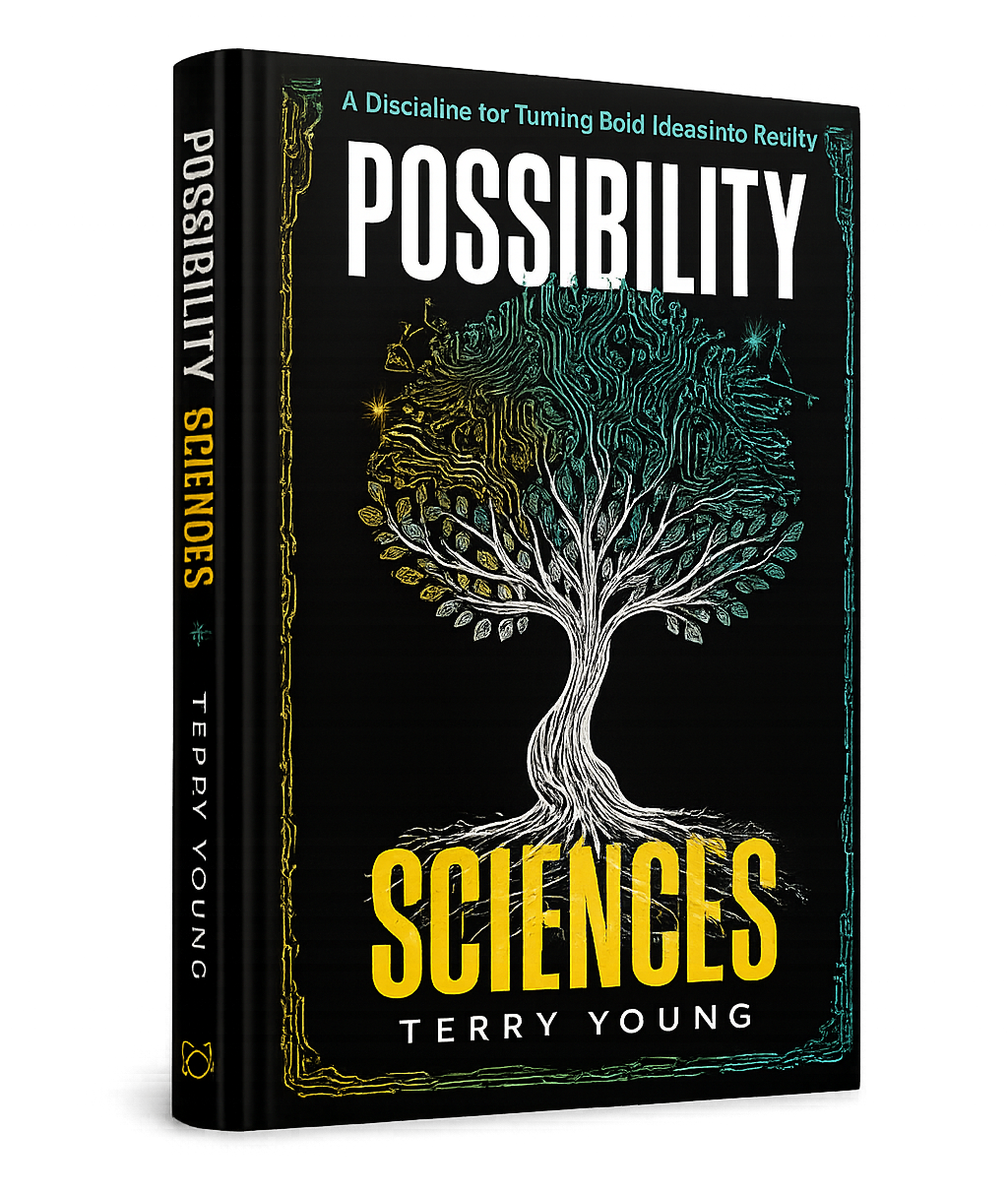
Possibility
Sciences
A Discipline for Turning Bold Ideas into Reality
Pre-Order Here
About the Book
We are living through a civilizational inflection point. The world is generating possibility faster than our systems are built to absorb it. The strain we feel today is the interest payment on decades of short-horizon reflexes.
Advances in science, technology, and human knowledge have expanded what humanity can imagine and build. Yet many of the structures meant to carry society forward remain designed for a different era, optimized for near-term certainty, operational efficiency, and incremental adjustment rather than for the scale, complexity, and ambition the century ahead will require.
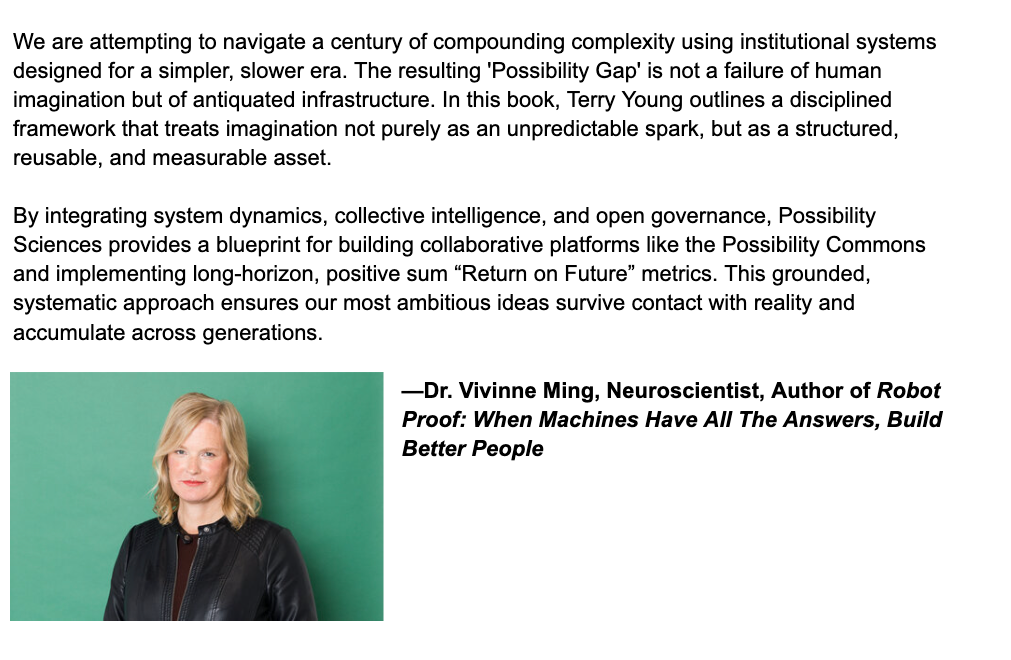
In Possibility Sciences, Terry Young introduces a new discipline for an age of accelerating change. At the center of the book is what Young calls the Possibility Gap: the institutional mismatch between accelerating human capability and the structures meant to turn it into progress. Too often, breakthrough possibilities are met by institutional habits that preserve the existing order rather than build the conditions for new systems to emerge. Young argues that closing the Possibility Gap requires a new discipline, one capable of protecting bold ambition from the forces that would pull it back into the logic of the past.
Through concepts such as Return on Future (ROF), Zero-Waste Innovation, shared knowledge infrastructure, cross-domain combinatorial innovation, simulations, and human-AI partnership, Young shows how societies can redesign the conditions under which bold ideas survive, compound, and take hold.
Written for leaders, builders, policymakers, and strategists across sectors, Possibility Sciences is not simply a book about innovation. It is a foundational argument for a century in which imagination alone will not be enough; institutions themselves must become more capable of turning bold possibility into systemic progress.
About Terry Young

Terry Young is a strategist, entrepreneur, author, and field-builder working at the intersection of culture, innovation, systems change, and human possibility. He is the founder of Possibility Sciences, an emerging discipline focused on helping people, organizations, and societies move breakthroughs from imagination into responsible, scalable action.
Terry previously founded and led sparks & honey, a cultural intelligence and innovation firm that helped organizations see around corners, understand emerging culture, and identify new territories for growth. Across his career, he has advised senior leaders, boards, companies, nonprofits, and public institutions navigating periods of disruption and reinvention.
His understanding of possibility has been shaped by work across cultures, including time in Europe, the United States, Asia, and Kazakhstan, as well as his service in the Peace Corps in Uralsk, Kazakhstan. He is currently building the nonprofit Possibility Institute alongside a broader ecosystem of platforms, tools, frameworks, communities, and ventures designed to advance Possibility Sciences as a new discipline for the age ahead.
Bulk orders
TBD
Who this book is for
Leaders trying to move beyond incrementalism.
Founders building new categories.
Investors looking for long-horizon value.
Policymakers facing systems-level complexity.
Educators preparing people for a radically different future.
Strategists, designers, researchers, and technologists working across boundaries.
Citizens who can feel that inherited systems are no longer enough.
And anyone carrying a bold dream that has not yet found a path.
10 things this book will help you do
Possibility Sciences will help you understand what is holding us back from solving our most complex problems, and give you the language and operating principles to practice a new kind of innovation. It offers a practical but ambitious way for leaders, organizations, and investors to move beyond short-term optimization and create breakthroughs with lasting human, civic, and commercial value.
You will learn how to:
Move beyond incremental innovation: See why short-term optimization can keep organizations busy without moving them toward the breakthroughs they need, and learn how to shift toward work that expands long-term human, civic, and commercial potential.
See possibility as a system, not just as your next idea: Understand why bold ideas often fail to become reality, and how systems can be designed to carry possibility forward.
Use Return on Future to measure long-term value: Learn how to evaluate whether ideas, investments, ventures, and strategies expand future options, strengthen systems, and create compounding value over time.
Break out of inherited paradigms: Recognize how old models of success, progress, leadership, and innovation quietly shape what people believe is possible, and learn when those paradigms need to be challenged, redesigned, or left behind.
Develop the mindset, skills, and reflexes of a Possibilian: Build the capacity to sense change earlier, challenge inherited assumptions, connect across domains, rehearse consequences, and act with imagination, discipline, and courage.
Use AI to expand imagination, not just accelerate execution: Discover how human judgment and machine intelligence can work together to test possibilities, surface unintended consequences, and design for outcomes beyond the next quarter.
Build innovation portfolios that stack over time: Move beyond isolated pilots and one-off initiatives by learning how to connect ideas, experiments, technologies, partnerships, and investments so each effort strengthens the next.
Make breakthrough ideas stick in community reality: Understand why promising ideas often stall when they meet real people, places, markets, institutions, and communities, and learn how they can be sequenced, governed, funded, adopted, and encoded.
Remix knowledge across fields for second and third uses: Learn how to find value in what already exists by reusing, recombining, and applying tools, ideas, data, and discoveries from one domain in unexpected new contexts.
Innovate with ethics, consequence, and stewardship: Learn how to evaluate trade-offs before ideas scale, protect against unintended harm, and build futures that expand possibility without narrowing the choices of those who inherit them.